Dave Kiss 点赞 opencode 的 AGENTS.md 规则:加复杂度前先讲清失败模式与成本,征得用户同意。
This is such a banger rule in @opencode's AGENTS.md

"Before adding complexity for a speculative or vanishingly unlikely race or security edge case, explain the concrete failure mode, likelihood, and complexity cost to the user and get their buy-in. Do not silently expand scope for theoretical robustness."
Matt Pocock 分享可复用提示词:让 Agent 扫描团队 GitHub PR 评审评论,归纳更新 CODING_STANDARDS.md。
Prompt of the day:

/retro take a look at as many GitHub PR review comments as you have access to from my team. Create suggestions for updates to CODING_STANDARDS.md (breaking into multiple files as needed).

Makes your PR comments inform the code going forward.
用 teams 角色、git worktree 隔离、文件锁与对手评审,把 Claude Code 配成多智能体协作团队。
Configure my Claude Code workspace for autonomous agent teams:

In ~/.claude/teams, create the missing roles. Workers run on Sonnet (medium effort) in separate git worktree branches. The adversary runs on Fable.
In ~/.claude/settings.json, set CLAUDE_CODE_EXPERIMENTAL_AGENT_TEAMS=1 and lock the main session to effortLevel: high.
Initialize tasks.json with file-level locking so workers can coordinate directly.
In CLAUDE.md, require an adversary review before any PR.

Show me the config diffs before applying anything.
Matt Pocock 分享一条让编码 Agent 复盘近 10 次会话、改进仓库导航以节省 Token 的提示词。
Prompt of the day:

/retro read my last 10 coding agent sessions and find ways to make my repo easier to navigate. Find where agents take too long to find relevant information, or rely on out-of-date docs.

Improving navigability is such an underrated way to save tokens.
Codex tip: once GPT-6.1 Sol is your main model, stop running Astra on every turn

put Astra on call as an architect agent

GPT-6.1 Sol keeps writing the code
Astra only gets spawned at three points:

→ before a plan: is this the right approach?
→ when the same error comes back: am I digging in the wrong place?
→ before "done": what did I miss?

Astra reviews. Sol ships

Jev engineering is the same move one layer down: the forks that need no thinker (which file, which tool, retry or stop) go to Jev in under half a second, and the big models only see the ones that split

- the full tree
> GPT-6.1 Sol on high runs the main session
> explorer reads the code on Luna
> worker edits and runs tests on Sol
> researcher pulls the docs on Luna
> all three on medium
> Astra on call as the architect
> auto_review checks every approval

paste the tree and this prompt into Codex ↓

"Rebuild my Codex setup around this tree:

1. Check ~/.codex/agents and .codex/agents for agents that already fit explorer, worker and researcher.

> Draft new TOML files only for missing roles
> explorer and researcher on gpt-6-luna, worker on gpt-6.1-sol, all with model_reasoning_effort medium
> Add an architect agent on gpt-6-astra, model_reasoning_effort high, whose only job is reviewing plans, repeated errors and finished work
> Skip any that pin a different model and list them

2. In ~/.codex/config.toml set model to gpt-6.1-sol, model_reasoning_effort to high and approvals_reviewer to auto_review

3. Find anything that would override this (active profiles, flags in my shell aliases, agents.default_subagent_model). Report it, change nothing

4. Add one rule to AGENTS.md: spawn the architect before a large plan, when an error repeats, and before calling a long task done

Show me every change as a diff first. No edits until I say go."

↳ https://t.co/eyMF8gZKLE
Dan McAteer 分享一条 Claude Code 病毒式提示词,用于审计提示中的过期路径、废弃命令与冲突指令。
Claude Coders: Run this prompt for Opus 5.5 *NOW*.

'/doctor prompt-audit'

Different from a viral post I had earlier this week because it prioritizes stale paths, obsolete commands, and conflicting instructions.
New favourite use case for opus 5.5:

Give them the whole repo and ask:

“Tell me what we should actually refactor.”

• an orchestrator maps the architecture and conventions
• it sends fresh read-only agents through every subsystem
• it validates, dedupes, and ranks the findings

The result: real code smells, dead code, duplication, and architecture issues instead of unnecessary AI nitpicks.

Prompt 👇
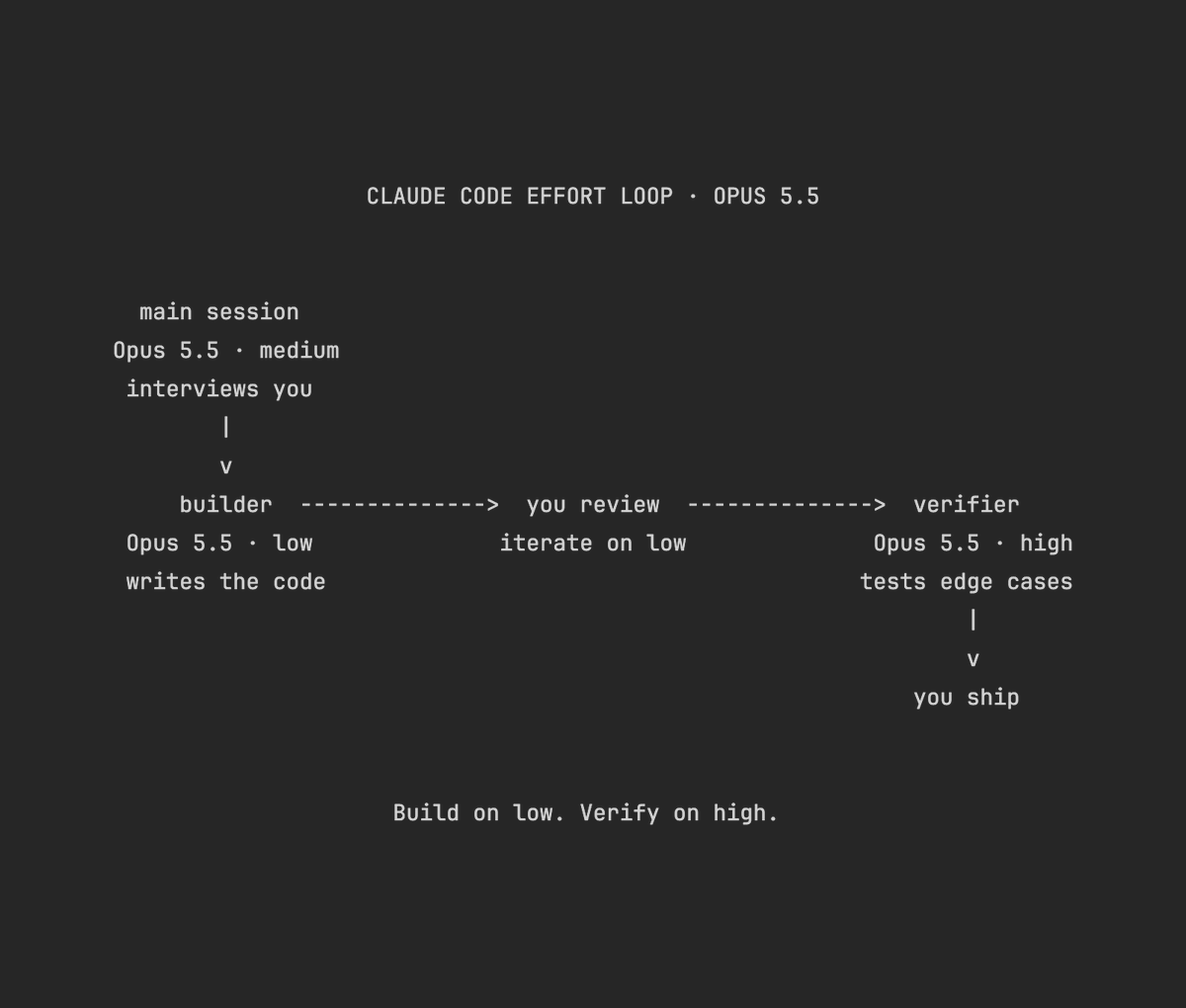
Thariq from Anthropic's Claude Code team just published his tests on effort: turning effort up mostly buys 𝗺𝗼𝗿𝗲 𝘃𝗲𝗿𝗶𝗳𝗶𝗰𝗮𝘁𝗶𝗼𝗻 𝗮𝗻𝗱 𝗲𝗱𝗴𝗲-𝗰𝗮𝘀𝗲 𝘁𝗲𝘀𝘁𝗶𝗻𝗴. You can turn his approach into 𝘁𝘄𝗼 𝘀𝘂𝗯𝗮𝗴𝗲𝗻𝘁𝘀 and have Claude Code follow it.

For new features, he works in four steps:
→ Have Claude ask you questions first and fill in what the spec is missing
→ Build it on low. It's fast, and you can step in anytime
→ Look it over, and if it needs changes, stay on low
→ Switch to high at the end to verify and test

If you want to try it, send this image and the prompt below to Claude Code 👇

"Set up the workflow in this image in my Claude Code:

1. Create two subagents in ~/.claude/agents:
- builder: writes the code. model: opus, effort: low. It implements the spec I've approved and stops when it's done.
- verifier: checks the work. model: opus, effort: high. It runs the feature first to see what it actually does, then adds tests, focusing on edge cases. It reports problems to me and doesn't change the code itself.

2. Add a rule to ~/.claude/CLAUDE.md: when I ask for a new feature, first ask me what the spec is missing; after I confirm, hand it to builder; after I've reviewed the result, hand it to verifier.

3. Check whether the environment variable CLAUDE_CODE_EFFORT_LEVEL is set. If it is, the effort settings on both subagents won't take effect. Just tell me; don't change it.

Show me the contents of the files you'll create or change, then explain the whole workflow in words a 10-year-old could follow. Don't write anything until I confirm."
Anthropic 详解 Opus 5.5 任务成本构成,给出 effort 分级、缓存命中率等降本策略与自查提示词。
Anthropic just published its 𝗳𝘂𝗹𝗹 𝗰𝗼𝘀𝘁 𝗴𝘂𝗶𝗱𝗲 for Opus 5.5. You can ask Opus 5.5 to use it to review your Claude Code setup.

At the same effort level, Opus 5.5 thinks more per turn than Opus 5, most of all at xhigh and max. Thinking is billed as output, and an output token costs 𝟭𝟬𝟬 𝘁𝗶𝗺𝗲𝘀 𝗮 𝗰𝗮𝗰𝗵𝗲 𝗿𝗲𝗮𝗱. So don't carry over the level you set for Opus 5. Start at medium, and save xhigh and max for work where you've measured a gain.

Send this prompt to Opus 5.5 👇

"Read this guide: https://t.co/8RHkfmiKjM

Then review my Claude Code setup against it: my user and project settings, the subagents in ~/.claude/agents and .claude/agents, CLAUDE.md, and the MCP servers I have connected. Find three kinds of problems:
1. A default effort that doesn't fit the work. Use the guide's ladder: low for mechanical edits, medium for well-scoped daily work, high when medium stalls, and xhigh or max only for work where a gain was measured. Flag a default of xhigh or max, or a level I picked for Opus 5. Then look at this project's code and recent commits and tell me which kinds of work here fit which level.
2. Subagents that only search, read logs or run tests but set no model, so they run on my main model.
3. Setup that makes every turn cost more: MCP servers I don't use, or a CLAUDE.md well over 200 lines.

For each issue, quote the setting or line, explain what it costs, and suggest the smallest change. Also tell me which three things to check in /usage at the end of a task.

Show me the recommendations first. Don't change anything yet."
通过代理审计请求内容并精简 settings.json,降低 Claude Code 会话启动上下文成本。
Here's a step-by-step process to kill all the bloat from your Claude Code system prompt:

1. Run a proxy so you can see exactly what gets sent to Claude Code (included in the article)
2. "Fuck, there is so much cruft in there"
3. Use my settings.json to kill all the bloat

Down to a clean 13K tokens to start each session with. Nice.

Full process here:

https://t.co/Kie84HMe2A
最近长时间用 codex,逐渐形成了这些自定义指令,挺好用的:

1. Fail Fast / Errors Never Pass Silently:不要在代码里藏兜底逻辑来吞掉错误、隐藏问题。出了问题就应该让它爆出来,否则你永远找不到真实问题。
2. Fix the Cause, Not the Symptom / Don't Paper Over Bugs:当一个问题出现时,不要用各种 small fix、针对性补丁来掩盖它。必须定位真实根因,彻底修复。在 bug 上糊纸只会让系统积累你不知道的危险暗病。
3. Make It Observable:即使问题很难定位,也绝不要偷懒做表面修复。应该给项目增加充分的日志和可观测性,保证下次问题再现时你有足够信息去定位。问题无法修复时,只需要诚实告诉我信息不足、需新增日志,不要假装修好了。
4. Design for Debugging / Traceability:始终注意在关键路径上给自己留足排查日志,确保每一个关键节点都是可追溯的。
5. Living Documentation / Single Source of Truth:当项目关键技术栈或产品方向发生变更时,同步更新 agents.md。文档必须随代码一起演进,不能让它变成过时的谎言。
6. Don't Break Mainline:大规模重构或实验性改动前,必须先切新分支。
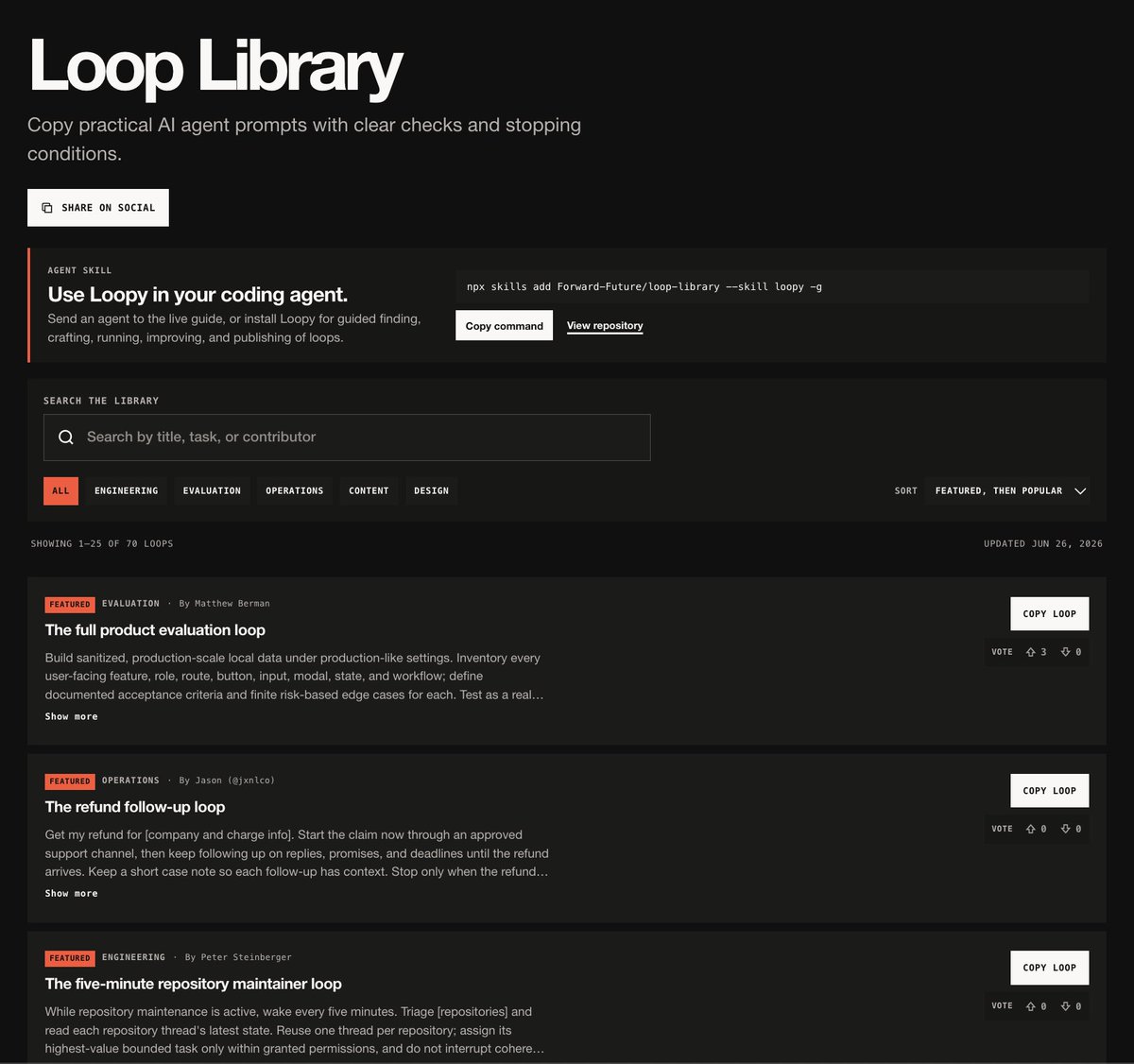
This is the best site on the internet to find agent loops you can use right now.

Free. Completely.

Most AI engineers are still writing these from scratch.

https://t.co/FHDHGXam6Z

Bookmark this site.

Then read this ↓ https://t.co/H5vkrn3UJ2