Dave Kiss 点赞 opencode 的 AGENTS.md 规则:加复杂度前先讲清失败模式与成本,征得用户同意。
This is such a banger rule in @opencode's AGENTS.md

"Before adding complexity for a speculative or vanishingly unlikely race or security edge case, explain the concrete failure mode, likelihood, and complexity cost to the user and get their buy-in. Do not silently expand scope for theoretical robustness."
Matt Pocock 分享一条提示词:用 pre-commit 钩子拦截超 5000 token 的文件,迫使 Agent 拆分模块、保持代码库整洁。
Prompt of the day:

Create a pre-commit hook that prevents files over 5,000 tokens. Tokens = bytes/4.

Run only on staged files. Ignore files which are not authored by agents, like lockfiles or codegen.

Provide explicit instructions on how to split files in the error message.

The simplest investment I ever made in my codebase. So good.
holy sh*t. Official Anthropic tip for Claude Code: stop burning Opus 5.5 context on tasks Haiku 5.5 can swarm, while Sonnet 5.5 builds

put the architect on call with /advisor

claude --advisor opus --subagents haiku

Sonnet 5.5 drives the primary session on high effort, writing diffs and running test suites
Haiku 5.5 subagents swarm the repo in parallel at 340 tok/s, handling file discovery and spec docs lookup
Opus 5.5 stays on call in the background as the advisor, only stepping in at three critical moments:

→ before a plan locks: does the implementation plan miss auth invariants or schema contracts?
→ when a test breaks twice: are we fixing the root cause or falling into a recursive rabbit hole?
→ before calling done: did the full diff introduce hidden regressions or break pre-flight rules?

Opus 5.5 reviews. Sonnet 5.5 builds. Haiku 5.5 swarms

Jev engineering runs the identical pattern one layer down: mechanical decisions that need no reasoning (which file to open, which tool to invoke, retry or abort) execute in 16ms, so the frontier models only wake up when execution paths actually diverge

Plan on high. Delegate on medium. Keep Opus on call.

- the full advisor setup
> Opus 5.5 on call reads full session history and catches deep architectural traps
> Sonnet 5.5 lead drives edits, writes core logic, and executes test harnesses
> Haiku 5.5 subagents swarm AST parsing, grep scans, and API docs in parallel
> JEV micro-fork layer resolves 1,500+ mechanical routing branches in under 16ms
> advisor stays completely silent on routine bash execution to protect context

paste the setup and this prompt into Claude Code below:

"Configure my Claude Code workspace for hierarchical advisor orchestration:

1. Audit ~/.claude/settings.json and project config for model roles fitting lead, subagents, and advisor:
> Pin main session model: sonnet with effortLevel: high for primary execution
> Pin subagents model: haiku with effortLevel: medium for parallel file discovery and docs retrieval
> Pin advisor model: opus on call for strategic review

2. Enable the advisor tool in ~/.claude/settings.json:
> Set advisorModel to claude-opus-5-5
> Enable subagent parallel dispatcher pool (3x workers)

3. Configure automatic advisor consultation checkpoints in ~/.claude/CLAUDE.md:
> Consult /advisor opus before finalizing multi-file architecture plans
> Automatically summon /advisor opus when the same test or compiler error fails twice
> Enforce advisor diff contract audit before declaring tasks complete or staging git commits

4. Constrain subagent scopes:
> Haiku subagents return structured AST summaries and docs snippets only without modifying main session context

Show every configuration diff first. Do not apply edits until confirmed"

↳
https://t.co/gvAWk6KbDn
Prompt of the day:

/writing-for-agents my AGENTS.md is a hot mess, propose a series of restructurings that:

- Remove no-ops
- Use progressive disclosure
- Move instructions to CODING_STANDARDS.md

Apply your work over three subagents, each more radical than the last. Create a single PR.

AGENTS.md is the most common source of token inefficiency. This prompt kills it dead.
Matt Pocock 分享可复用提示词:让 Agent 扫描团队 GitHub PR 评审评论,归纳更新 CODING_STANDARDS.md。
Prompt of the day:

/retro take a look at as many GitHub PR review comments as you have access to from my team. Create suggestions for updates to CODING_STANDARDS.md (breaking into multiple files as needed).

Makes your PR comments inform the code going forward.
Matt Pocock 分享的 Agent 技能提示词,通过删除测试找出浅模块与冗余抽象,持续精简代码库。
mattpocock/skills prompt of the day:

/codebase-design Take a look in the repo for shallow modules, applying the deletion test and look for candidates for deletion.

Helps kill unnecessary abstractions.
Matt Pocock 分享一条让编码 Agent 复盘近 10 次会话、改进仓库导航以节省 Token 的提示词。
Prompt of the day:

/retro read my last 10 coding agent sessions and find ways to make my repo easier to navigate. Find where agents take too long to find relevant information, or rely on out-of-date docs.

Improving navigability is such an underrated way to save tokens.
Codex tip: once GPT-6.1 Sol is your main model, stop running Astra on every turn

put Astra on call as an architect agent

GPT-6.1 Sol keeps writing the code
Astra only gets spawned at three points:

→ before a plan: is this the right approach?
→ when the same error comes back: am I digging in the wrong place?
→ before "done": what did I miss?

Astra reviews. Sol ships

Jev engineering is the same move one layer down: the forks that need no thinker (which file, which tool, retry or stop) go to Jev in under half a second, and the big models only see the ones that split

- the full tree
> GPT-6.1 Sol on high runs the main session
> explorer reads the code on Luna
> worker edits and runs tests on Sol
> researcher pulls the docs on Luna
> all three on medium
> Astra on call as the architect
> auto_review checks every approval

paste the tree and this prompt into Codex ↓

"Rebuild my Codex setup around this tree:

1. Check ~/.codex/agents and .codex/agents for agents that already fit explorer, worker and researcher.

> Draft new TOML files only for missing roles
> explorer and researcher on gpt-6-luna, worker on gpt-6.1-sol, all with model_reasoning_effort medium
> Add an architect agent on gpt-6-astra, model_reasoning_effort high, whose only job is reviewing plans, repeated errors and finished work
> Skip any that pin a different model and list them

2. In ~/.codex/config.toml set model to gpt-6.1-sol, model_reasoning_effort to high and approvals_reviewer to auto_review

3. Find anything that would override this (active profiles, flags in my shell aliases, agents.default_subagent_model). Report it, change nothing

4. Add one rule to AGENTS.md: spawn the architect before a large plan, when an error repeats, and before calling a long task done

Show me every change as a diff first. No edits until I say go."

↳ https://t.co/eyMF8gZKLE
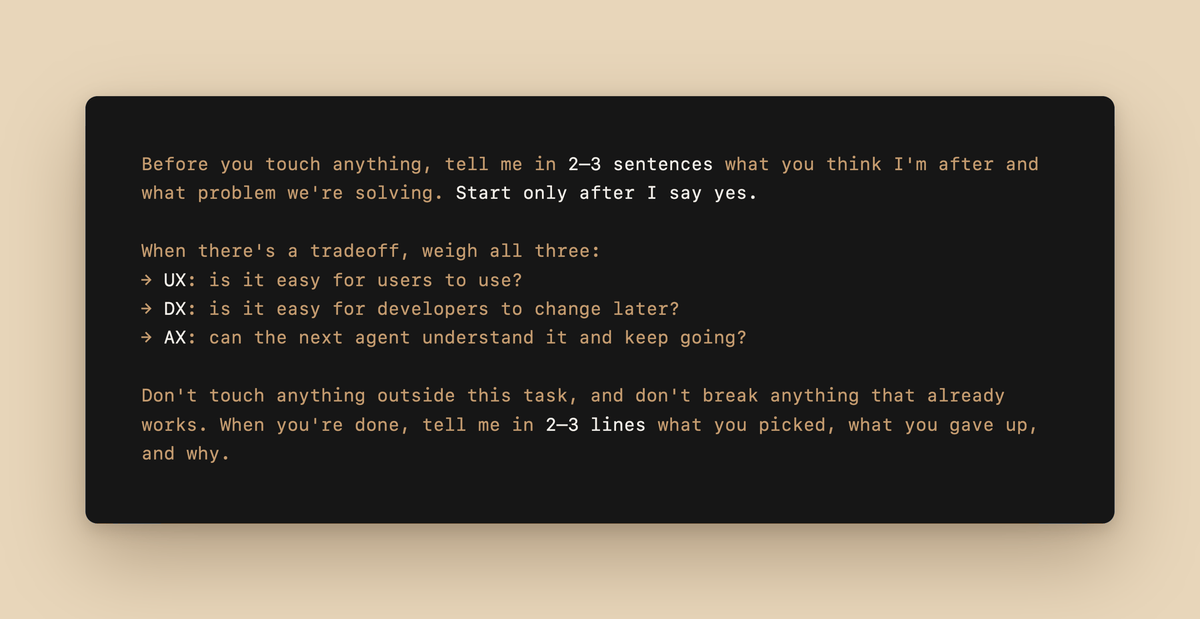
一条可复制的提示词:让 Claude Code/Codex 先确认理解、按 UX/DX/AX 权衡决策、不越界不破坏现有功能。
When you hand Claude Code or Codex a long task, add this. If it misunderstood you, 𝘆𝗼𝘂'𝗹𝗹 𝗰𝗮𝘁𝗰𝗵 𝗶𝘁 𝗿𝗶𝗴𝗵𝘁 𝗮𝘄𝗮𝘆:

"Before you touch anything, tell me in 2–3 sentences what you think I'm after and what problem we're solving. Start only after I say yes.

When there's a tradeoff, weigh all three:
→ UX: is it easy for users to use?
→ DX: is it easy for developers to change later?
→ AX: can the next agent understand it and keep going?

Don't touch anything outside this task, and don't break anything that already works. When you're done, tell me in 2–3 lines what you picked, what you gave up, and why."
Dan McAteer 分享一条 Claude Code 病毒式提示词,用于审计提示中的过期路径、废弃命令与冲突指令。
Claude Coders: Run this prompt for Opus 5.5 *NOW*.

'/doctor prompt-audit'

Different from a viral post I had earlier this week because it prioritizes stale paths, obsolete commands, and conflicting instructions.
用 5 个 Opus 子代理并行巡检上线前 20 项设计与体验问题并一次修复,附 Opus 5.5 成本与 effort 分级策略。
Claude Code tip: before you ship a vibe-coded site, have Opus 5.5 send out 𝟱 𝘀𝘂𝗯𝗮𝗴𝗲𝗻𝘁𝘀 to check 𝘁𝗵𝗲𝘀𝗲 𝟮𝟬 𝘁𝗵𝗶𝗻𝗴𝘀, then fix them all in one pass:

Consistent design
→ Write a DESIGN.md first, and make every color, font size, spacing and corner radius follow it
→ Keep the palette restrained and the type hierarchy clear
→ Make every button, card and input of the same kind look alike
→ Too flat? Add emphasis. Too crowded? Cut
→ Keep text readable on both dark and light backgrounds

On mobile
→ No sideways scrolling, and nothing spilling off the screen
→ Add a mobile menu
→ Make buttons big enough to tap
→ Keep the layout intact when the text is enlarged

Every state
→ Give loading, empty and error states a proper screen
→ Give every button feedback, with its own hover, pressed and disabled look
→ Show form errors right where they happen, plus submitting, success and failure messages
→ Add transitions to modals, dropdowns and tab switches

Use it like a real user
→ Click through the core flows, like sign-up and checkout, from start to finish
→ Find buttons that do nothing and links that are broken
→ Make sure the whole thing works with just a keyboard

Before launch
→ Say what you do in one line on the home page
→ Give each page one main button you want people to click
→ Give every page a title, a description and a favicon
→ Delete all placeholder text

For effort, follow Anthropic's cost guide from yesterday: medium is for well-scoped daily work. The default medium is enough for these 20 fixes; raise it for the harder ones. Thariq tested it: turning effort up mostly buys more verification and edge-case testing.

Send this whole post to Claude Code. If you need to, add this line at the end 👇
"Send one subagent per group to check it without editing anything. Then fix everything yourself from their lists, so no two agents edit the same file. If a group is more complex, raise that subagent's effort. Show me the list of issues first, don't change anything until I confirm, and when you're done, give me before-and-after screenshots."
New favourite use case for opus 5.5:

Give them the whole repo and ask:

“Tell me what we should actually refactor.”

• an orchestrator maps the architecture and conventions
• it sends fresh read-only agents through every subsystem
• it validates, dedupes, and ranks the findings

The result: real code smells, dead code, duplication, and architecture issues instead of unnecessary AI nitpicks.

Prompt 👇